About Dollar Shave Club
Dollar Shave Club is one of the most recognized subscription brands in the world. They deliver grooming products — razors, blades, and personal care — to hundreds of thousands of subscribers on a recurring basis, with the majority of revenue tied directly to those recurring transactions.
The economics of a subscription business put unusual pressure on every individual payment. When a first rebill fails, the cost is not just the revenue from that transaction. It is the entire acquisition investment behind a customer who signed up, expressed clear intent, and left before the relationship had a chance to generate returns. Nick Reshamwalla, VP of Engineering, Architecture and Data at Dollar Shave Club, was responsible for understanding and improving that conversion rate. What he found when he finally looked closely at the payment infrastructure changed how the whole team operates.
The Challenge: Two Years of Retry Logic No One Had Questioned
"Our retry logic was rules-based, which effectively means it's static. We tried a number of different variables — not just the number of retries, but the days in between. We found that those were all deficient."
— Nick Reshamwalla, VP of Engineering, Architecture & Data, Dollar Shave Club
That's Nick's description of the setup his team inherited: a fixed retry cadence, applied uniformly regardless of failure reason, running largely unexamined for the better part of two years.
Recovery rates were at 8.2%. Dollar Shave Club was losing roughly 22,000 subscribers a month to a combination of active and passive churn. Nick frames the stakes simply: when a business loses five percent of its customers in a given month, it needs to acquire sixty percent more just to hold its base. The retry logic had been contributing to that gap, but because nothing looked visibly broken, it had gone largely unexamined. That turned out to be the most expensive assumption the team was making.
The Hidden Cost: Why More Retries Made Things Worse
When recovery rates are low, the instinct is to retry more. Nick's team had tested that instinct directly, running an A/B test between five retries spaced three days apart and seven. The result was unambiguous: varying the cadence made no meaningful difference. More attempts weren't the answer. The problem ran deeper than timing. The system had no way of knowing why a payment had failed, so every retry was firing blind.
Visa and Mastercard track retry behavior at the merchant level. A pattern of high-frequency, undifferentiated attempts sends a risk signal, one that affects how future transactions are evaluated, including ones from customers with valid cards and no intention of churning. At a certain point, aggressive retrying doesn't just fail to recover revenue. It raises the probability of declines on transactions that would otherwise have cleared.
Dollar Shave Club had crossed that threshold. The retry logic was spending money to hurt the metric it existed to improve.
"If your retry logic is unintelligent, you can't just retry over and over again. There's a cost — both to your merchant score and your MID reputation, and there are hard financial costs associated with every processing attempt. The more aggressive we were, the more money I would actually lose."
— Nick Reshamwalla, VP of Engineering, Architecture & Data, Dollar Shave Club
The Solution: Replacing Rules with Signal
The shift for Dollar Shave Club was replacing a static, volume-based approach with intelligent, signal-driven recovery through Revaly. Rather than applying a uniform retry cadence regardless of context, the system analyzes each decline individually using machine learning trained on billions of transactions to determine why a payment failed and whether a retry is likely to succeed.
An expired card gets a different response than insufficient funds, which gets a different response than a temporary processing error. The platform retries when issuer and network signals indicate a real probability of recovery and holds off when the math says a retry would cost more than it recovers.
For Nick's team, this resolved a question they hadn't been asking correctly. The A/B tests on retry cadence were optimizing the wrong variable. The real question was never how often to retry. It was whether to retry at all and when.
The Results: Millions Recovered, and a Richer Picture of the Business
After implementing Revaly, Dollar Shave Club increased recovery rates from 8.2% to 14.6% — a 78% net improvement — unlocking millions in additional annual recovered revenue. The financial outcome was significant. The more consequential shift was in what the team could now see.
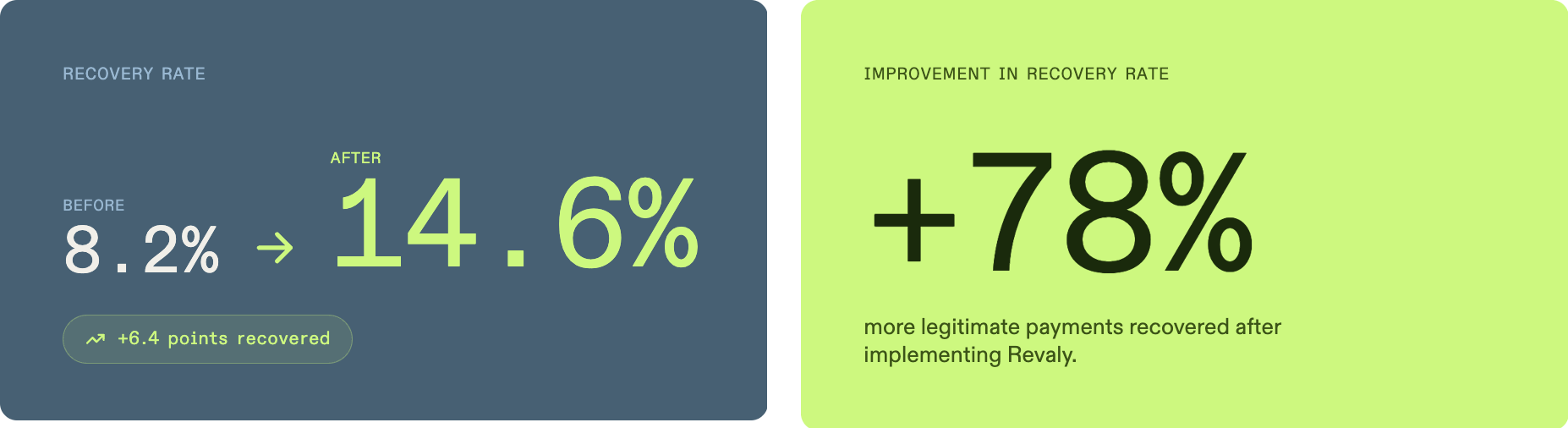
- Recovery rate moved from 8.2% to 14.6%
- 78% net improvement in recovery rate
- Millions in additional annual recovered revenue
Visibility into why payments were failing — not just that they were — unlocked a layer of insight that had never been accessible before:
- Which payment methods correlate with longer customer lifetime value
- Which customer profiles carry higher first-rebill churn risk
- How AOV thresholds and payment method criteria should shape subscription eligibility and pricing
The same data that improved recovery also helped the team understand where customer value was being created, where it was being lost, and which payment behaviors should influence acquisition, pricing, and retention strategy.
Nick built a dedicated retention team around what the data was surfacing. Payment performance became an input into business strategy, one that informed decisions across engineering, finance, and growth, rather than a metric the payments team managed in isolation.
What's Next
For any subscription business still running rules-based retry logic without having seriously examined it, Nick's advice is straightforward: go look at the numbers. The gap between where most businesses are and where they could be has a real dollar value attached to it, and it compounds quietly every month it goes unexamined.
"It's a big number. But I like my job, so I don't want to share it. My only regret is that I didn't look at the payment infrastructure sooner."
— Nick Reshamwalla, VP of Engineering, Architecture & Data, Dollar Shave Club