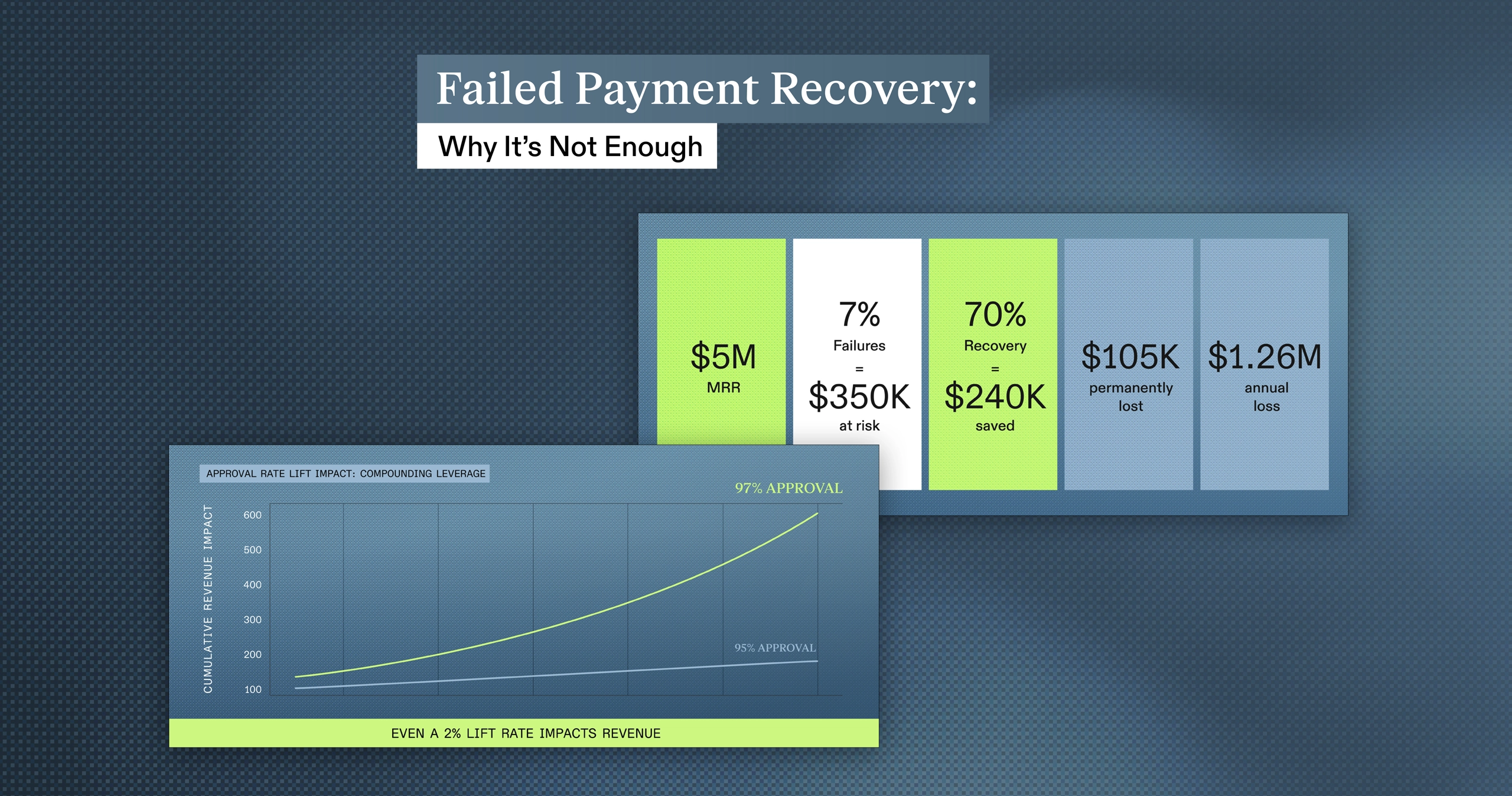
Failed payment recovery software covers a wide range of products, from basic retry and dunning tools to platforms that improve payment performance before and after a decline.
Vendors also calculate recovery differently. Some measure recovered payments against all failed transactions, while others only count the transactions their software attempted. Some focus exclusively on recovery after a decline, while others also work to prevent failures on the first payment attempt. These differences make headline recovery rates difficult to compare.
This guide explains the main approaches, where each one fits and what to ask when evaluating vendors.
- Key Takeaways
- Failed payment recovery software ranges from basic post-decline tools to platforms that also improve first-attempt approvals.
- Recovery rates are not directly comparable until you know how they are calculated and what types of recovery they include.
- The right approach depends on your payment setup, transaction volume and whether you need to recover failed payments, prevent them or both.
- Built-in tools may be sufficient for simpler payment environments. Dedicated software becomes more valuable when recovery has plateaued or greater payment complexity requires a more tailored approach.
- Before choosing a vendor, ask how it measures incremental impact, what the integration requires and how much ongoing work it will create for your team.
What Does Failed Payment Recovery Software Do?
Failed payment recovery platforms use a range of capabilities to recover declined transactions. Common capabilities include updating expired or replaced payment credentials, understanding the decline, selecting the right retry timing and treatment, and contacting customers when their action is required.
The exact mix varies by platform. Some focus primarily on retries and customer communication, while others can resolve payment issues earlier in the lifecycle.
Card and account updates
Card and account updater services retrieve current payment information when a card expires, is lost or is replaced.
When updated credentials are available, the platform can apply them automatically and continue the recovery process without asking the customer to enter new information.
Coverage depends on the card network, issuer, region and availability of updated credentials, as Stripe's own documentation on automatic card updates lays out.
Decline analysis and treatment
The decline response helps determine what should happen next.
More advanced platforms evaluate the decline reason and available payment signals before choosing a treatment. Depending on the issue, that may mean correcting payment data, adjusting AVS logic, retrying immediately or moving the transaction into a longer recovery process.
Some platforms also support payment routing, transaction formatting, workflow orchestration and reporting. Buyers should look at the full set of treatments available rather than assuming every decline will enter the same retry flow.
Smart retries
Basic retry systems attempt a payment again on a fixed schedule. Smart retries use payment signals to determine whether and when another attempt should be made.
The word "smart" can mean different things depending on the provider. Stripe Billing uses payment data from across its network to select retry times. Recurly says its intelligent retry engine combines decline codes, payment metadata and patterns learned across its merchant base.
Revaly's intelligent retry engine analyzes each failed transaction using machine learning trained on billions of transactions. It combines decline signals, payment history, payment lineage, and issuer and network intelligence to determine:
- Whether the payment should be retried
- When another attempt is most likely to succeed
- Which recovery treatment is most appropriate
- When retrying could create unnecessary risk
This goes beyond selecting a retry date. The engine determines the recovery path for each payment based on the reason it failed and the signals available across the payment lifecycle.
For Immunotec, this replaced a system of three fixed retries that treated every failure the same way. After implementing Revaly, recovery improved by 20-35% across its markets, while recurring approval rates moved from below benchmark to above benchmark.
Customer outreach: dunning and Smart Outreach
Traditional dunning uses emails, SMS or in-app messages to ask the customer to update their payment method or resolve an issue with their account. Some platforms also use the term to describe the broader process of retrying the payment and managing what happens to the subscription if recovery fails.
Dunning can recover payments that require customer action, but every message introduces friction. The customer has to see it, respond and complete the update before the subscription lapses.
The experience matters too. A poorly timed or overly aggressive sequence can create unnecessary concern for a customer who had no intention of leaving.
Revaly uses Smart Outreach as an alternative to a standard dunning sequence. When customer action is required, Revaly uses payment context and behavioral science to determine the timing, sequence and channel most likely to generate a response.
Outreach can be delivered through email, SMS and other compliant digital channels, with the messaging and design adapted to the merchant's brand. The goal is to involve the customer when their action is necessary without turning every failed payment into a collections experience.
Used together, these capabilities can address several common causes of failed payments. Their effectiveness depends on why the payment failed, which transactions the platform can act on and how intelligently it selects the next treatment.
What Don't Recovery-Only Tools Solve?
Traditional recovery tools mainly focus on what happens after a payment fails. Card updater services are an exception because they may refresh payment details before the next charge.
Retries and customer outreach respond to a decline that has already happened. They can choose another time to submit the payment or ask the customer to intervene, but they have limited ability to change how the original transaction was presented to the issuer.
This leaves several areas unaddressed:
- Incomplete or inconsistent transaction data
- Routing and formatting issues
- Authentication problems
- Outdated tokens
- Fraud controls that block legitimate customers
- Issuer-specific approval patterns
- Preventable false declines, including why valid recurring payments get declined in the first place
A broader approach works across the full transaction lifecycle:
##TABLE:tbl-lifecycle##
Recovery still plays an important role. Understanding why recovery alone has a ceiling is what separates a partial fix from a complete one.
Should You Use Native Recovery Features, Build In-House or Buy a Dedicated Platform?
Before adding another product to your payment stack, check which recovery features are already included in your payment processor or subscription billing platform.
Stripe Billing, for example, can automatically retry failed payments, send customer emails and update eligible saved cards.
Subscription billing and revenue management platforms such as Recurly and Chargebee also offer combinations of retries, account updates and dunning. These are native features because they are included within the systems already managing subscription billing or payment processing.
For some businesses, those capabilities are enough. Others need more control, more specialized optimization or clearer measurement of incremental revenue.
##TABLE:tbl-buildvsbuy##
When native processor or billing features make sense
Native features are usually the most practical place to start. They are already connected to your billing data, require limited implementation and cover common recovery methods.
They may be enough when:
- Payment volume is relatively low
- Your billing setup is straightforward
- You use one processor or billing platform
- Recovery is not a major source of revenue loss
- Your team does not need highly customized logic or reporting
The limitation is how far built-in recovery tools can adapt to your specific customer base, decline patterns and payment stack.
ClinicSense was already using Stripe Billing and recovering 38% of its failed payments. By integrating Revaly directly with Stripe Billing, it increased recovery to 64%, a 69% improvement over its existing baseline.
When building in-house makes sense
Building internally gives you the most control. Your team can create its own retry rules, customer journeys, reporting and experimentation framework.
It may make sense when:
- Payments are a core internal capability
- You have dedicated payments, data and engineering resources
- Your billing model requires highly specialized logic
- You need complete control over orchestration
- Existing tools cannot support your requirements
The initial build is only part of the investment. The real tradeoffs of building payment recovery in-house tend to show up after launch: retry strategies need to be tested, network rules change, integrations require maintenance and reporting must separate real lift from payments that would have recovered anyway.
Dollar Shave Club had spent two years testing its own rules-based retry logic. Recovery remained at 8.2%. After implementing Revaly, recovery reached 14.6%, a 78% relative improvement that recovered millions in additional annual revenue.
Hooked on Phonics also built its own recovery system, which consistently recovered 14% of failed payments. Revaly later recovered an additional 45% beyond that internal system, outperforming the company's expectations by 150%. The customers Revaly recovered went on to have similar lifetime value to customers whose payments had never failed.
When a dedicated platform makes sense
A dedicated platform becomes more compelling when small improvements in approval or recovery rates create meaningful financial impact.
It may be worth evaluating when:
- You process a high volume of recurring payments
- Existing tools have reached a performance ceiling
- You operate across several processors, gateways or billing platforms
- Your team lacks the resources to maintain recovery logic internally
- You need clearer measurement of incremental lift
- You want to improve first-attempt approvals as well as recovery
The platform should still earn its place in the stack. Ask what it does beyond your current tools, how the improvement will be measured and how much work implementation will require from your team.
Five Questions to Ask Before Choosing a Provider
1. How is the recovery rate calculated?
Ask what the rate includes. Is it based on all failed payments or only those the software attempted to recover? Does it include payments recovered through account updates or customer action? Also check whether improvements are reported as absolute or relative. An increase from 10% to 15% is five percentage points, but a 50% relative lift.
2. Does the software prevent failures or only recover them?
Some software only retries payments after they fail. Others can also improve transaction data, routing and authentication before the first attempt. Ask the vendor what happens before authorization and which types of failures the software can prevent.
3. What data does the software use?
A webhook sent after a payment fails provides less information than a direct connection to your payment stack. Ask what data the software receives, how quickly it receives it and whether it works across your billing platform, gateways, processors and CRM. Confirm that it can also handle multiple currencies, payment methods and decline types.
4. Can the vendor prove the incremental impact?
A successful retry does not necessarily mean the software caused the recovery. Some payments would have succeeded on a later attempt anyway. Ask how the vendor establishes a baseline and whether it uses control groups or holdouts to measure the additional payments it recovered.
5. What will the software require from your team?
Confirm who will manage the integration, how long implementation will take and what ongoing support will be required from engineering, payments, finance and customer success. A fully managed solution should not create another system your team has to operate.
What Is Payment Performance Management?
Payment Performance Management extends payment optimization across the full transaction lifecycle. It works to improve first-attempt approvals, resolve recoverable declines in real time and intelligently recover the payments that still fail.
Revaly brings these capabilities together within its Payment Performance Management platform:
##TABLE:tbl-ppmstages##
The platform combines merchant transaction data with issuer and network intelligence to select the appropriate treatment at each stage.
This approach is designed for businesses that have already implemented basic recovery and need to improve the performance of the payment system as a whole.
What this looks like across different businesses
##TABLE:tbl-results##
The results vary because every business begins with a different payment stack, baseline and customer mix. The relevant question is how much additional performance the platform can create beyond what is already in place.
How Should You Choose?
Start with your current performance.
Document your failed payment rate, recovery rate, first-attempt approval rate and the recovery features already available through your processor or billing platform. Make sure every metric has a clear definition.
Then compare the options:
- Use native processor or billing features when you need straightforward retries, card updates and customer communication.
- Build internally when payments are a core capability and your team can maintain the system over time.
- Evaluate a dedicated platform when existing tools have reached their limit and incremental improvements justify the investment.
- Consider Payment Performance Management when the opportunity extends beyond recovery into first-attempt approvals and real-time decline treatment.
Choose failed payment recovery software based on measurable incremental lift, the internal effort required and the revenue it can protect—not headline recovery rates.
Frequently Asked Questions
What is failed payment recovery software?
Failed payment recovery software helps businesses collect recurring payments that were declined on the first attempt. Capabilities can include account updates, decline analysis, smart retries, payment routing, dunning, behavioral outreach and recovery reporting.
What is the difference between payment recovery and dunning?
Dunning is the customer communication and account-management part of recovery. It typically includes emails, SMS, in-app prompts and rules for what happens to the subscription after a payment fails.
Payment recovery is the broader process. It can also include account updates, decline-specific treatments and smart retries that do not require customer action.
Revaly uses Smart Outreach as an alternative to a predefined dunning sequence, tailoring the timing, channel and message when customer action is required.
Are Stripe's built-in recovery tools enough?
Stripe Billing's native recovery tools can provide a useful baseline through Smart Retries, customer emails and automatic card updates.
They may be enough for businesses with straightforward billing and lower payment volume. Businesses seeking more customization, cross-platform data, issuer and network intelligence, first-attempt optimization or independently measured lift may need an internal or dedicated solution.
Should you build payment recovery in-house?
Building in-house can make sense when payments are a core capability and the business has dedicated engineering, data and payments resources.
The decision should account for ongoing testing, maintenance, compliance and reporting, not only the initial development effort.
When should you use a dedicated payment recovery platform?
A dedicated platform is most relevant when failed payment volume is high, existing tools have reached a performance ceiling or small improvements would create substantial revenue.
The provider should demonstrate incremental performance beyond your current baseline.
Can failed payments be prevented?
Some payment failures can be prevented by improving transaction data, stored credentials, routing, authentication and alignment with issuer requirements before authorization.
Other failures, such as insufficient funds or closed accounts, may still require retries or customer action.
How Revaly Fits Into Your Existing Payment Stack
Revaly is designed to connect with the systems your team already uses rather than requiring a full payment-stack replacement.
The platform supports more than 100 integrations across:
- CRMs
- Subscription billing platforms
- Payment gateways
- Payment processors
- Customer communication systems
Connections can be made through existing integrations or a custom implementation. Businesses can keep their current processors, billing workflows and customer systems while Revaly adds intelligence and orchestration across the payment lifecycle.
Once connected, Revaly helps:
- Prevent avoidable failures by cleaning and structuring payment data
- Resolve recoverable declines using real-time, decline-specific treatments
- Select the right timing and strategy for each retry
- Use Smart Outreach when customer action is required
- Measure the incremental revenue protected and recovered
This approach has worked across very different environments. Revaly connected to Immunotec's Exigo CRM and multi-processor setup without requiring a payment-flow rebuild. It integrated directly with Stripe Billing for ClinicSense. Through ROI Solutions, it operates inside the Revolution CRM environment used by nonprofit fundraising teams. Special Olympics also connected Revaly with its CRM and Worldpay teams through what the organization described as a quick, effective implementation.
The goal is to improve payment performance without forcing your team to abandon the systems that already run the business.
Explore Revaly's integrations or talk to our team about the approval and recovery opportunity within your current payment setup.