Most subscription businesses know their churn rate. Fewer know how much of it they caused themselves.
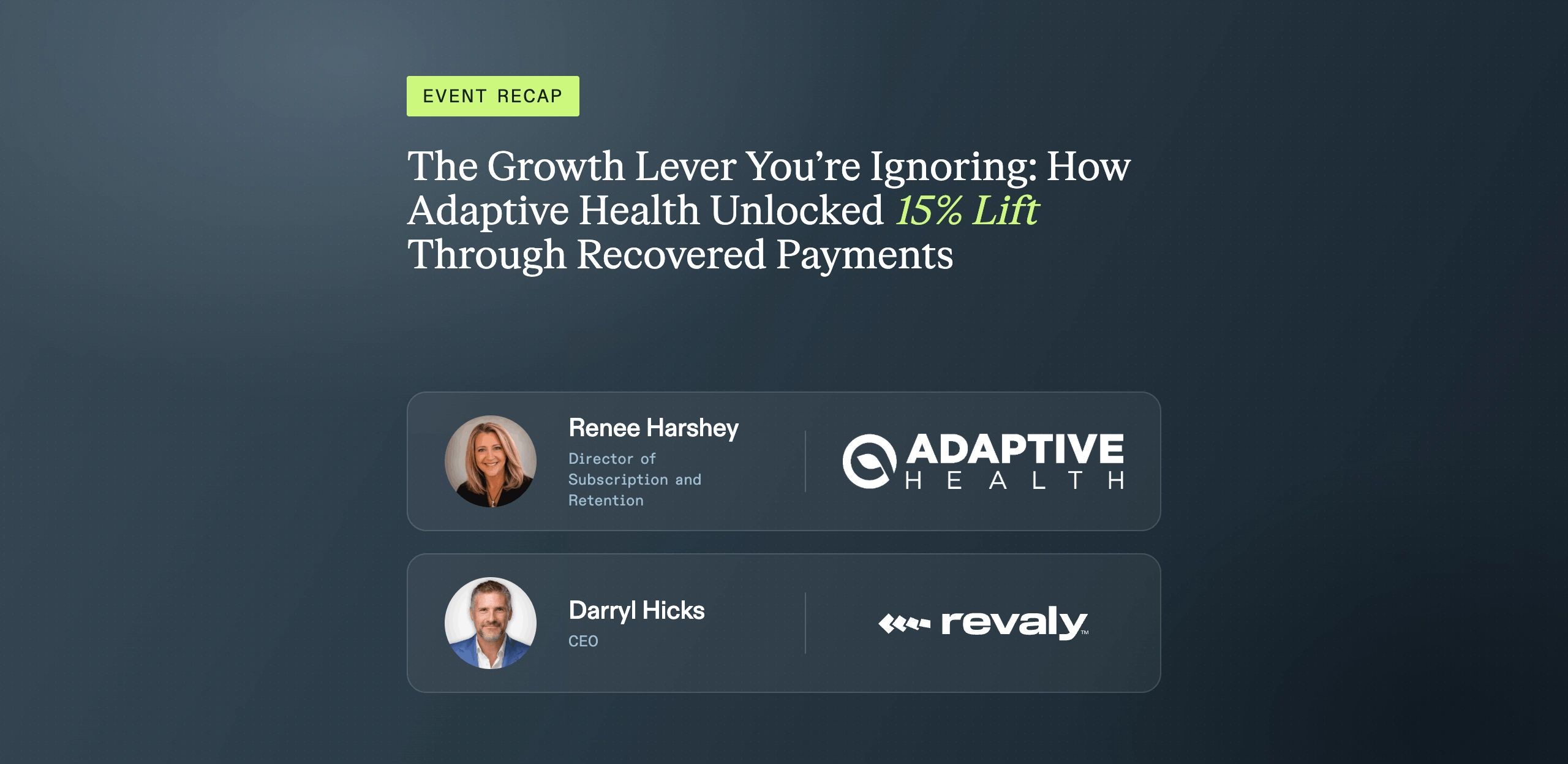
When a payment fails and a subscriber disappears, the instinct is to record the loss and move on. The card declined, the retry didn't convert, and the customer is gone. What the data doesn't show — not without digging — is how many of those failures were preventable, how many subscribers had no intention of leaving, and what three extra billing cycles on each recovered customer would have been worth. Renee Harshey, Director of Subscriptions and Retention at Adaptive Health, saw an opportunity hiding inside the churn numbers that nobody had modeled yet. She shared the full story at SubSummit KC 2026, in a fireside conversation with Revaly CEO Darryl Hicks.
The session covered a lot of ground. Here's what stood out.
The problem hiding in the payment stack
When Harshey first started asking questions about payment recovery at Adaptive Health, the picture she got back looked solid. Retries were running. An account updater was in place. A dunning series was live. Her instinct was that "working" and "optimized" weren't the same thing, so she pulled her analyst to find out. The question they went looking for wasn't what the recovery process looked like — it was what the recoverable revenue was actually worth. Nobody had modeled the downstream value of a recovered subscriber, the additional billing cycles, the lifetime extension, the avoided re-acquisition cost. Once they did, the number reframed the entire conversation around what the recovery program deserved in terms of attention and investment.
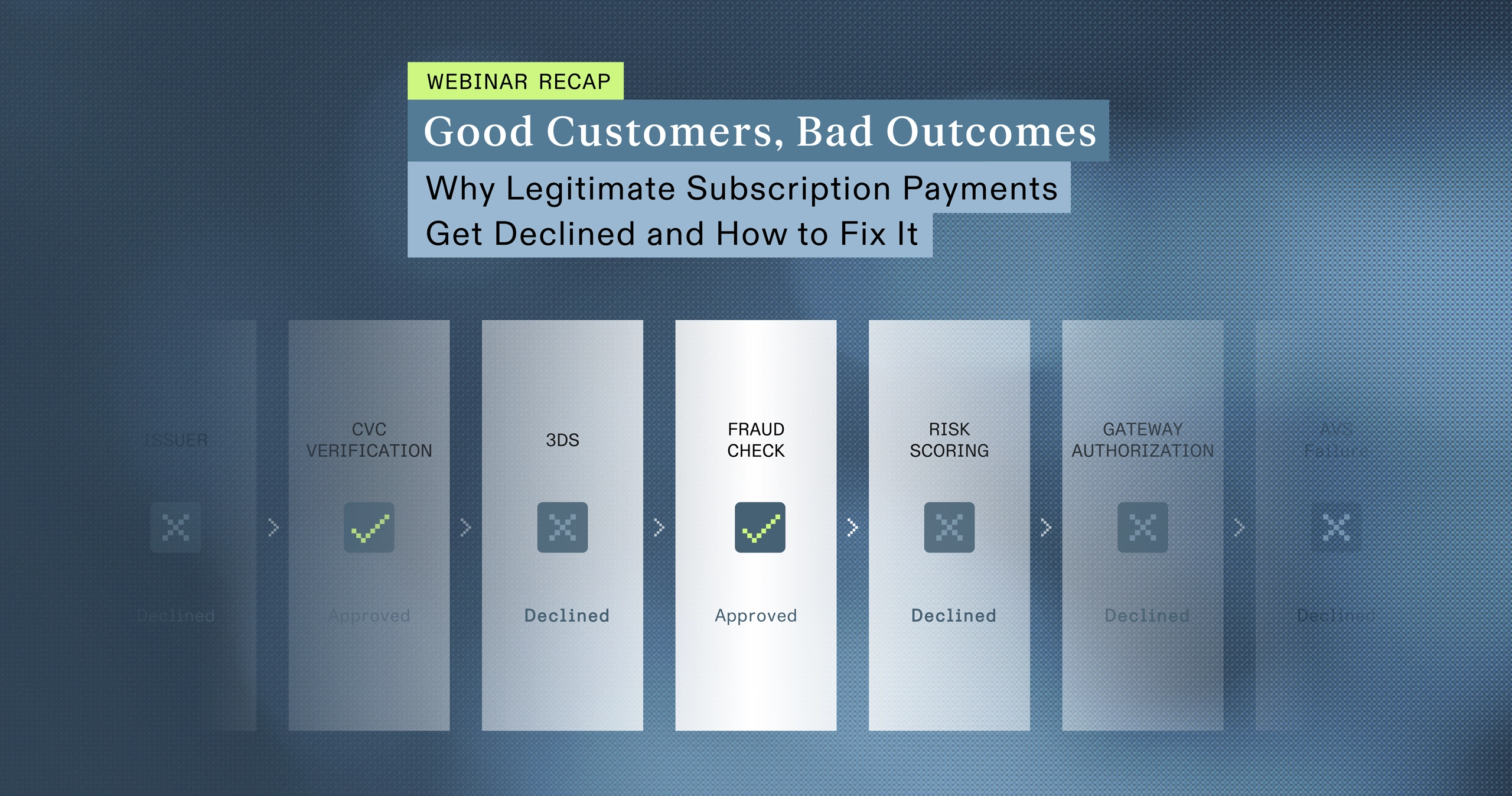
Most teams collapse all failed payments into a single bucket, which makes the problem look simpler than it is. Decline codes break into three meaningful categories: insufficient funds, hard declines — lost, stolen, closed accounts, invalid CVV — and a large middle category of false declines that accounts for more than half of all failures for the typical US subscription merchant. False declines don't come from customers leaving or from billing infrastructure failing — they come from card-issuing banks running fraud rules that flag legitimate recurring transactions as suspicious. The subscriber never canceled and is still expecting their next shipment, but a filter ended the relationship on their behalf, and unless someone goes looking for it, the revenue loss gets recorded as churn and the customer gets counted as gone.
The number that moved the CEO
Harshey's CEO came from a startup background, someone who had built the company's platforms and infrastructure from the ground up and believed deeply in owning what you build. The idea of bringing in an outside vendor for something as core as payment recovery was a hard sell. What shifted the conversation was data. Harshey took six months of Adaptive Health's transaction history, ran it through Revaly's models, and came back with a projection: here's what we're leaving on the table, here's what it would cost to fix it, and here's why we can't build this ourselves.
That last point is the one that tends to land hardest with technical founders. Revaly works directly with card-issuing banks, pulling signal from billions of transactions across hundreds of merchants to train the models that inform retry timing, sequencing, and decisioning. No single merchant can accumulate that breadth of data on their own, regardless of scale — and that's what closed the argument with Adaptive Health's CEO. They agreed to a test.
After partnering with Revaly, Adaptive Health improved recovery rates by roughly 15% in the first division, enough to get attention, but not what ultimately moved leadership. What moved leadership was a question Revaly's team asked that Harshey's hadn't thought to ask before: what happens to recovered customers afterward? For Adaptive Health, a physical subscription business, the answer was three additional shipments per recovered customer — not one rescued payment, but three more billing cycles on top of the initial save. When Harshey modeled a two-percentage-point improvement in recovery rates multiplied by three additional cycles per customer, the number in front of her CEO wasn't a retention metric anymore. It was a revenue projection built entirely on customers who had already been acquired, already converted, and never signaled they wanted to leave.
"This is money that's due to us," she said at SubSummit. "The customer signed up for our products. They're expecting to get their shipment. They can't because there was an issue with their credit card processing."
Why this is a marketing problem as much as a payments problem
Harshey is direct about what made her different: she owned recurring revenue, so the failure points inside it were hers to care about. People in her role — responsible for retention metrics, cycle rates, and subscriber lifetime value — are often the ones best positioned to see this opportunity because they're already asking what a customer is worth over time, which means a failed payment isn't an ops problem that landed on their desk, it's a gap in the number they're accountable for closing.
It was just her and her analyst, Mitzi, driving the case internally, without a payments department or dedicated infrastructure. Two people who were passionate enough to keep pushing, through leadership changes and years of internal skepticism, until the numbers made the argument for them. Her message to anyone in a similar position: you don't need a payments team to do this. You need the right partner and someone willing to run the math.
What it actually takes to close the gap
Dunning and retries work within the limits of what a merchant can see: their own transaction history and their own customer data. What they can't see is the issuer side: which banks are running elevated decline rates, which fraud rules are generating false positives, what network-level signals would change the retry approach. Early results from Adaptive Health's second division are tracking even higher than the 15% lift in the first, in part because that division had been running a more aggressive in-house retry strategy, which meant more room to improve when intelligent decisioning replaced brute-force retries.
The shift the industry has been waiting for
Recovery is valuable, but it's still treating the symptom. What Hicks described at SubSummit as the next frontier is something the payments industry has been working toward for nearly a decade: preventing declines before they happen, rather than chasing them after the fact.
The mechanism is a direct partnership between Revaly and card-issuing banks, relationships built over years of data sharing that have now matured into something more structural. Rather than Revaly receiving transaction data from issuers and using it to optimize retries, the new model creates preferential treatment rails: merchants sharing fraud signals from their side, issuers sharing decline rationale from theirs, with the result that legitimate transactions from known subscribers get evaluated differently at the point of authorization. A proof-of-concept launched last August with a select group of merchants — several of them processing billions of dollars annually in the US — is showing roughly a 35% reduction in failed payments on those rails.
For most mid-market subscription businesses, this kind of issuer relationship has historically been out of reach. The Fortune 10 of subscription companies maintain dedicated issuer outreach programs and can get on the phone with fraud teams at major banks. Companies doing $200M to $600M a year rarely have the scale or the standing to earn those conversations. What Revaly is building is a way to extend that access and to let a mid-market subscription brand benefit from the same issuer intelligence that only the largest merchants have ever been able to tap.
Hicks framed the ambition plainly: willing participants engaging in legal commerce shouldn't face friction. It's not a complicated idea. It's just not how the ecosystem has worked — until now.
The questions worth running before the next billing cycle
If you know your churn rate, the next question is how much of it is involuntary. If you know your involuntary churn, the next question is how much of it is recoverable. And if you know your recovery rate, the question most teams still haven't answered is what the downstream LTV looks like on the customers they do recover. Each of those questions has a number attached to it, and until you run them, you're forecasting a loss you don't have to take. Harshey's only regret, after years of building the case, was not starting sooner.
Watch the SubSummit session or talk to our team to see what payment performance could look like for your business.